
The Empty Parking Lot
Another Year Ends
Issue #32
The Empty Parking Lot
The last bus pulled out at 3:47.
You know the exact time because you watched it go.
Stood at the window in your office and watched the brake lights disappear around the corner at the end of the access road.
Then you turned around.
The building was still yours. The list was still there. The summer calendar was already filling up.
But the kids were gone.
And for right now, that was the only thing that mattered.
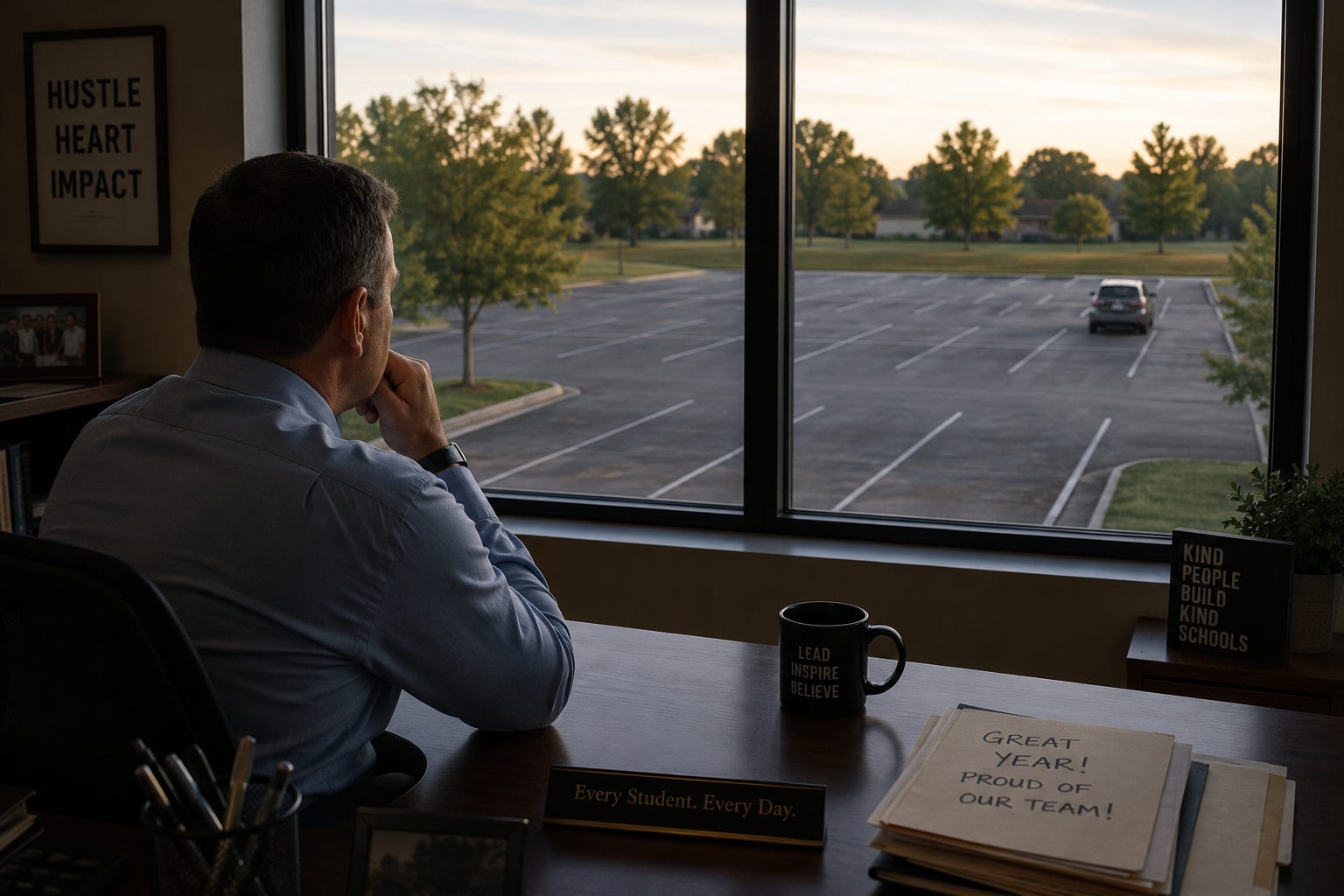
The campus is silent now.
Not the silence of a Sunday morning or a holiday weekend. This is a different kind of silence. Earned. The kind that only settles in after ten months of noise.
You walk down the main hallway one more time. No particular reason. Just walking.
The trophy cases are still lit. Someone forgot to turn them off. You make a mental note, then let it go. It can wait until Monday. Everything can wait until Monday.
You push through the side door and step into the parking lot.
Your car is the only one left.
You don’t get in it yet.
Here is something nobody talks about in this job.
The last day of the school year is the only day all year when the weight of it becomes visible to you.
Not during it. After it.
When the buses are gone and the hallways are empty and you’re standing in a parking lot that forty-five minutes ago held two hundred cars, something happens to a principal. Something quiet and private that you don’t mention to anyone. Not your family. Not your staff. Not your superintendent.
You run the year.
You think about the kid you never quite reached.
Not the ones you failed dramatically. The quiet ones. The ones who came through every single day, sat in every class, ate lunch alone in the back corner of the cafeteria, and left in June the same way they arrived in August.
You knew something was off. You’d see them in the hallway and make a note to yourself. Check in. Follow up. Find out what’s underneath that flatness in their eyes.
And then your radio would go off. Or the front office would buzz. Or a parent would be waiting. And the note you made to yourself would quietly disappear under the weight of everything else that needed you right now.
And they would come back tomorrow. There was always tomorrow.
Until there wasn’t.
You think about the teacher you were too hard on in October.
You know the one. Strong teacher. Genuinely committed. Struggling with something personal that was bleeding into the classroom in ways that were starting to affect kids. You had the conversation. You had to. It was the right call.
But you delivered it too sharp. Too efficiently. Too much principal, not enough person.
They came back the next day and did their job. And the day after that. All year.
But something shifted. And you noticed. And you told yourself you’d come back to it when things slowed down.
Things never slowed down.
You think about the decision you second-guessed from January. The one you’re still not sure about. Whether you got it right. Whether you got it wrong. Whether it was one of those calls that just doesn’t have a right answer and you carried it around for six months pretending otherwise.
You’ll probably carry it through the summer too.
This is the part of the job that doesn’t appear in any job description.
The accounting.
Not the formal kind. Not the spreadsheets and data reports you’ll submit before you leave for the break. The internal kind. The one you run alone in a parking lot when nobody is watching, and the only standard you’re measuring against is the one you set for yourself before the year started.
How close did you get?
And here’s the thing. Here’s what separates the principal who comes back in August ready to go from the one who comes back in August already tired.
The accounting has to be honest. But it also has to be complete.
You have to count what you missed. Every principal misses things. If you don’t account for what you missed, you’ll miss the same things next year.
But you also have to count what you held together.
The student who was two absences away from failing the year in March and graduated on time in May because you made one phone call to the right person at the right moment. The new teacher who was ready to quit in November and finished the year stronger than anyone on the staff because you sat with them for thirty minutes on a Wednesday afternoon and told them what you actually saw. The parent you never won over but kept in relationship with anyway, because you understood that the relationship mattered more than winning.
These count too.
The parking lot is getting dark.
You get in your car.
You sit there for a minute.
You’re not done. You’re not finished. You’re not leaving because the year is over. You’re leaving because this particular chapter is.
The difference between being done and leaving for the year is the same as the difference between a principal who carries their regrets and a principal who uses them. One of those principals comes back in August with a list. The other comes back with a plan.
You know which one you are.
You always have.
You start the car.
The parking lot is empty.
September is ten weeks away.
You already know it won’t be long enough.
It never is.
And you’re coming back anyway.
THE TRANSFERABLE PRINCIPLE THIS WEEK
Every school leader does a year-end reflection. The question is whether you do it honestly or just go through the motions.
Sitting with it in June, before you lock up and drive away, is an act of professional discipline. It forces you to name what you missed before you can decide what to do differently in August.
But the reflection only serves you if it goes both directions. Account for what fell short. Account for what held. Both tell you something about who you are in this job and who you want to be when the buses come back.
The school leader who leaves in June carrying only regret is not being reflective. That school leader is stuck.
Leave with the regret. Leave with the wins too. Then come back with a plan built from both.
Until next time — the chair is yours.


