
The First Warning
Student Behavior & Discipline — Part One
Issue 30 | THE FIRST WARNING
You didn’t think much of it the first time. Most principals don’t. That’s usually how it starts.
Jonathon was a ninth grader who is used to be invisible. Not in a bad way. Some kids are steady and quiet and present without demanding anything from you. They blend into the daily rhythm of the school, rarely drawing attention but always dependable. Their quiet presence can sometimes make it easy to overlook subtle shifts in their behavior or mood.
His teachers liked him. His attendance was solid. He showed up, did his work, and went home.
Then he didn’t.
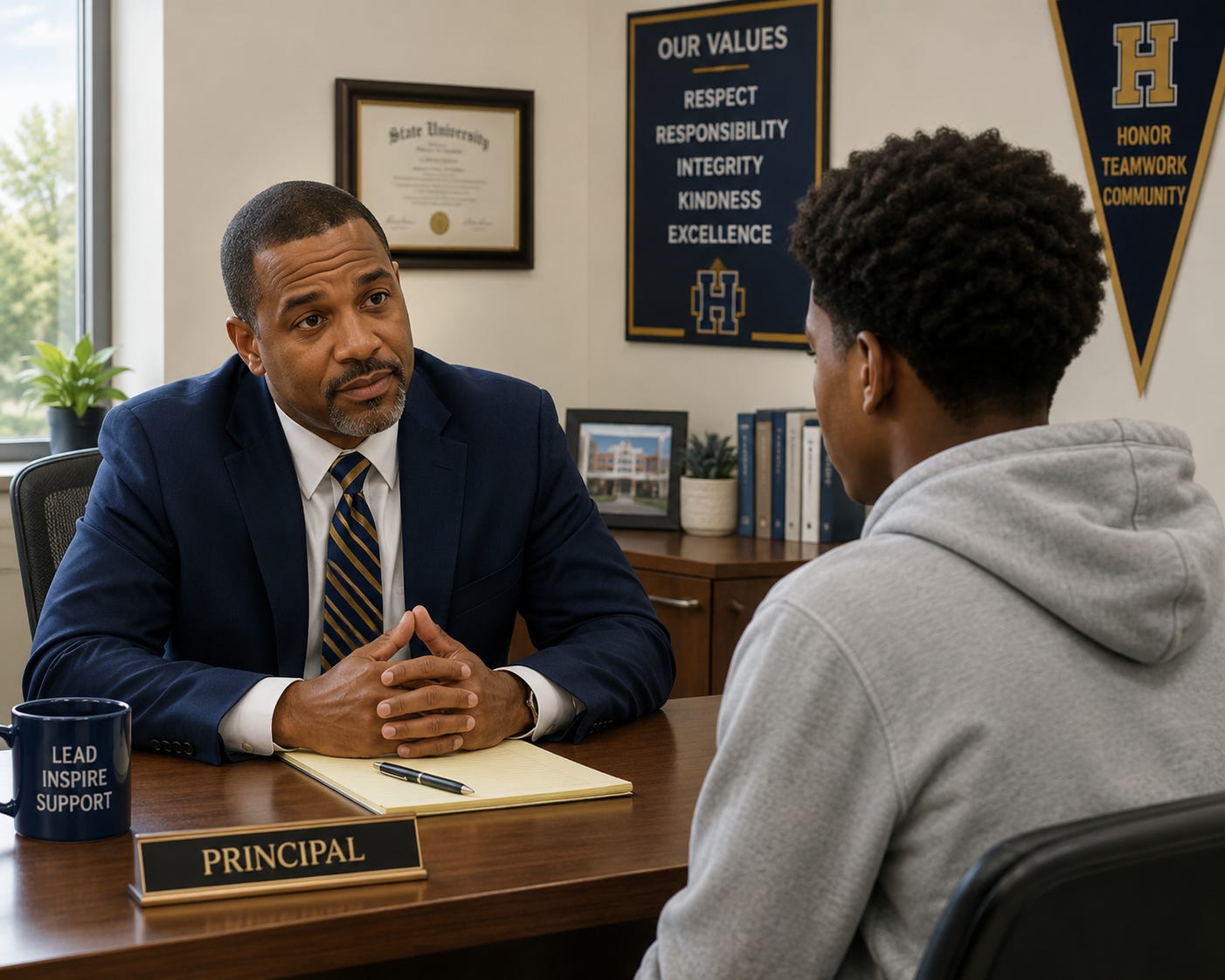
The first office referral came from Mr. Patterson in third period. “Refused to work. Wouldn’t respond when redirected.” You read it twice because the name didn’t fit the behavior. You called Jonathon in. He sat across from you with his arms crossed and said almost nothing. You gave him the grace-and-warning conversation. He nodded. You sent him back to class.
Three days later, another referral. This one from the hallway.
You told yourself it was a phase. You’ve been doing this long enough to know that kids go through things — family stuff, friend stuff, the invisible weight of being fourteen. You gave it space.
But here’s what nobody teaches you in your principal prep program: the early warning is almost never loud. It doesn’t announce itself. It shows up in the margins — repeated referrals, small changes in a kid who used to be predictable. And if you’re busy, if you’re running from meeting to meeting, if your inbox is full and your schedule is impossible, you miss it. Or you log it and move on.
You called Jonathon’s mom. She was working a double shift and couldn’t talk long. “He’s been different at home too,” she said. “I don’t know what’s going on.”
That sentence should have been the moment.
Instead, you made a note in the student file and told your counselor to check in when she had a chance. She had 147 other kids on her caseload. She did her best.
What you didn’t do was slow down. What you didn’t do was sit with Jonathon the next morning before first period — not about behavior, not about referrals, not about consequences — just talk. What you didn’t do was ask his teachers separately: has anything happened? Has anyone heard anything? Does anyone know what’s going on in this kid’s life?
You had the information. It came to you in pieces through the slow drip of referrals and a worried phone call, and you treated it like paperwork instead of a signal.
Here’s the thing about early warnings in student behavior: they are gifts. Expensive, uncomfortable, easy-to-dismiss gifts. A kid acting out is a kid communicating. Every principal knows that in theory. The job is to know it in practice — when you’re tired, when you have a board presentation due, when the budget meeting ran long and you haven’t eaten since six in the morning.
You have systems for this. Or you should. Intervention teams. Tier 2 supports. Counselor check-ins. Early identification protocols. But systems only work when a person with authority decides they matter more than what’s already on the calendar.
That person is you.
When a student shifts — when the behavior changes, when the referrals start stacking up, when a teacher says “I don’t know what’s gotten into him” — that is your cue. Not to refer and move on. Not to document and wait. To lean in.
Jonathon needed someone to lean in about six weeks before things got serious. Not a program. Not a referral to an already-overwhelmed counselor. A person. A conversation. A principal who noticed and decided that one kid was worth an hour of unscheduled time.
You had an hour. You spent it on other things.
That’s not condemnation. That’s this work. But it’s worth considering, because the next Jonathon is already in your building. He’s quiet. He’s showing up. He’s just starting to slip.
Are you watching?
TRANSFERABLE PRINCIPLE
In student behavior, the early warning is almost never dramatic. It’s the slight shift in a kid who used to be predictable. The job of a principal isn’t just to respond to crises — it’s to see them coming. That requires slowing down long enough to actually notice individual students, and then deciding that a kid in trouble is worth more of your time than whatever else is on the calendar. Build systems, yes. But never outsource the noticing.
Until next time — the chair is yours.
Next issue: The situation the warning was warning you about.
theprincipalschair.substack.com


