

The Post

Issue #107
The Post
It started as a post.
Then a screenshot of the post.
Then a screenshot of the screenshot.
By midnight it had been shared four hundred times. By morning my phone had sixty-three unread messages. Parents I hadn’t spoken to in years. Community members I had never met. A local news reporter asking for a statement before eight o’clock.
The post accused one of my teachers of misconduct.
It named him. It named the school. It named me.
And half the people who read it had already decided it was true.
The teacher’s name was Mr. Callahan.
Eleven years in my building. Ninth grade English. The kind of teacher who stayed late, knew every kid’s name, coached the speech and debate team on his own time. Well-liked. Trusted. The kind of colleague other teachers went to when they needed advice.
The post claimed he had made inappropriate comments to a student.
It offered no specifics. No date. No context. Just the accusation, a name, and a school.
That was enough.
I want to tell you I handled the first hour well.
I did not.
My first instinct was to defend him. Eleven years of trust, dozens of parent compliments in my files, a spotless record — I knew this man. And everything I knew said the accusation didn’t fit.
My second instinct was to say nothing publicly and wait for it to pass.
Both instincts were wrong.
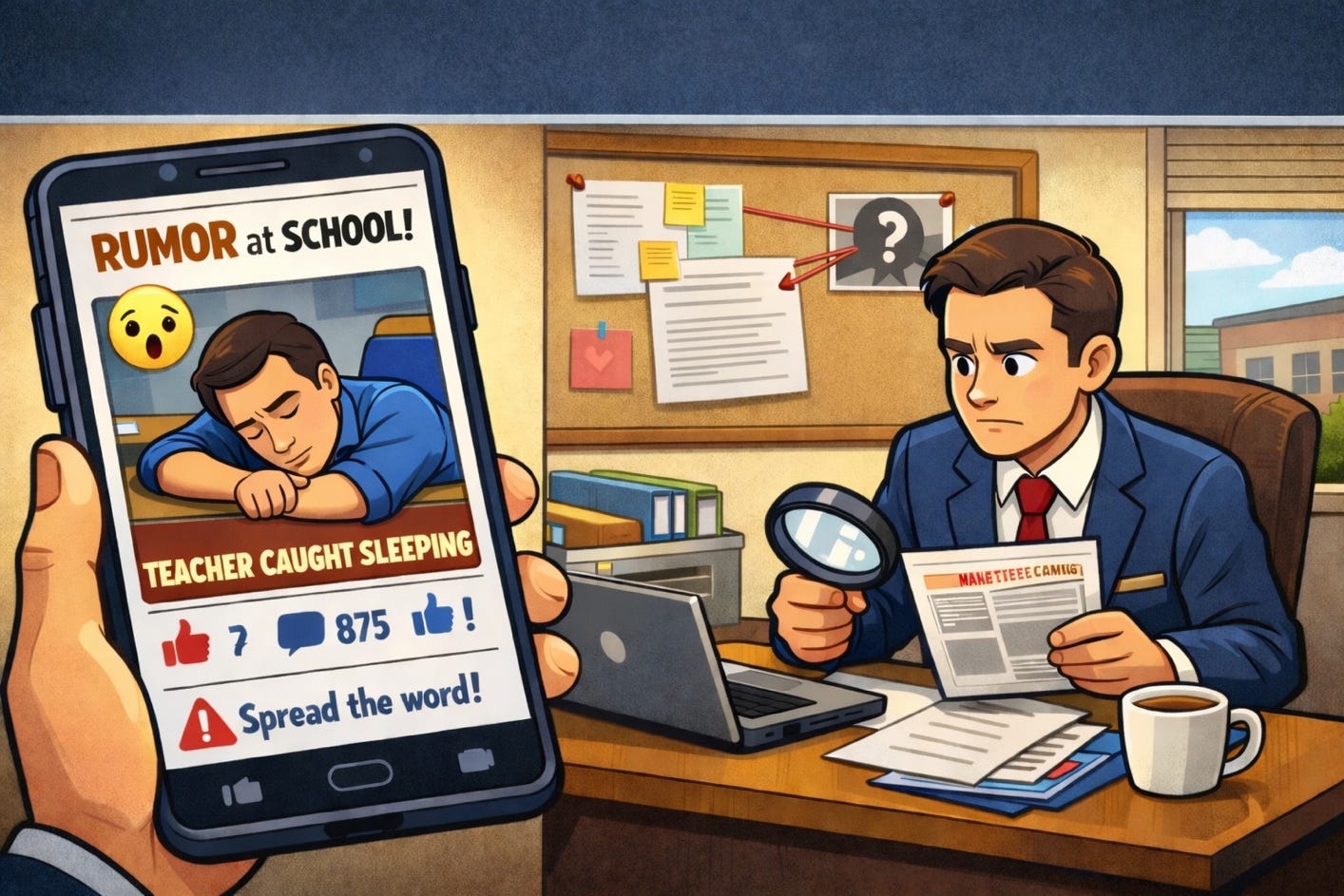
Here is what I have learned about social media accusations and leadership — the hard way, in real time, with my name in the thread.
Silence reads as guilt.
Defense reads as cover-up.
And the truth — whatever it turns out to be — moves at a fraction of the speed of the original post.
What a leader has to do in that moment is the hardest thing imaginable.
You have to hold two things at the same time that feel like they contradict each other.
The first: every accusation deserves a serious, thorough, fair investigation. Every one. Regardless of how well you know the person. Regardless of how implausible it sounds. Because the alternative — deciding in advance that something couldn’t have happened — is how institutions fail the people they were built to protect.
The second: an accusation is not a conviction. A post is not evidence. And a person’s reputation — their career, their family, their name — deserves to be protected from the momentum of a news cycle until facts are actually known.
I called Mr. Callahan at seven-fifteen that morning.
I told him what was happening. I told him I was taking it seriously. I told him I was also not going to treat him as guilty before a single fact had been established.
Then I called the district. Then HR. Then our legal team.
And then I wrote a statement — one paragraph, measured, careful — that said the school was aware of the post, that we take all concerns about student safety seriously, and that a proper review was underway.
I did not name him. I did not defend him. I did not dismiss the concern.
I said: we are looking into this, and we will follow the process.
The investigation took eleven days.
What it found was this: a comment Mr. Callahan had made in class — about a novel the students were reading — had been heard differently by one student than he had intended it. There was no pattern of behavior. No prior complaints. No corroboration. The student’s concern was real and it was heard. The comment was addressed directly with Mr. Callahan, who was genuinely shaken that his words had landed the way they did.
No misconduct. No discipline.
A conversation that should have happened in the classroom before it ever reached the internet.
The post, of course, was never updated.
The shares did not come back.
The four hundred people who saw the accusation never saw the outcome.
That is the thing about social media and institutional trust that no communications training fully prepares you for.
The accusation travels at the speed of light.
The truth travels on foot.
Mr. Callahan came back to his classroom.
He was quieter for a while. More careful with his words — not in a bad way, in a thoughtful way. He told me months later that it had changed how he thinks about the weight a single sentence can carry in a room full of teenagers.
I told him I understood.
It had changed how I think about a few things too.
THE TRANSFERABLE PRINCIPLE THIS WEEK
When an accusation goes public before the facts are known, a leader’s job is not to choose sides. It is to hold the process. Investigate seriously, protect the accused from presumption of guilt, and protect the community from presumption of innocence. Say less than you want to. Move faster than feels comfortable. And remember: the accusation will always travel farther than the outcome. Your job is to make sure the process is so thorough and so fair that you can live with it — regardless of what it finds.