

What Happens When the Federal Money Stops
Rinse/Repeat: DOE Reduction

The memo comes in late June. It’s from your district’s federal programs coordinator. The subject line is: “Title I Preliminary Allocation Update.” You open it expecting a number. What you find is a paragraph. The paragraph uses the word “reduction” three times. The last sentence says: “Building-level impact assessments are due July 15.”
Federal education funding has never been more uncertain. Changes at the Department of Education, shifting guidance on Title I distributions, and ongoing policy debates about what the federal government owes to high-poverty schools have created a situation where school leaders can no longer assume that the money coming this year will match last year.
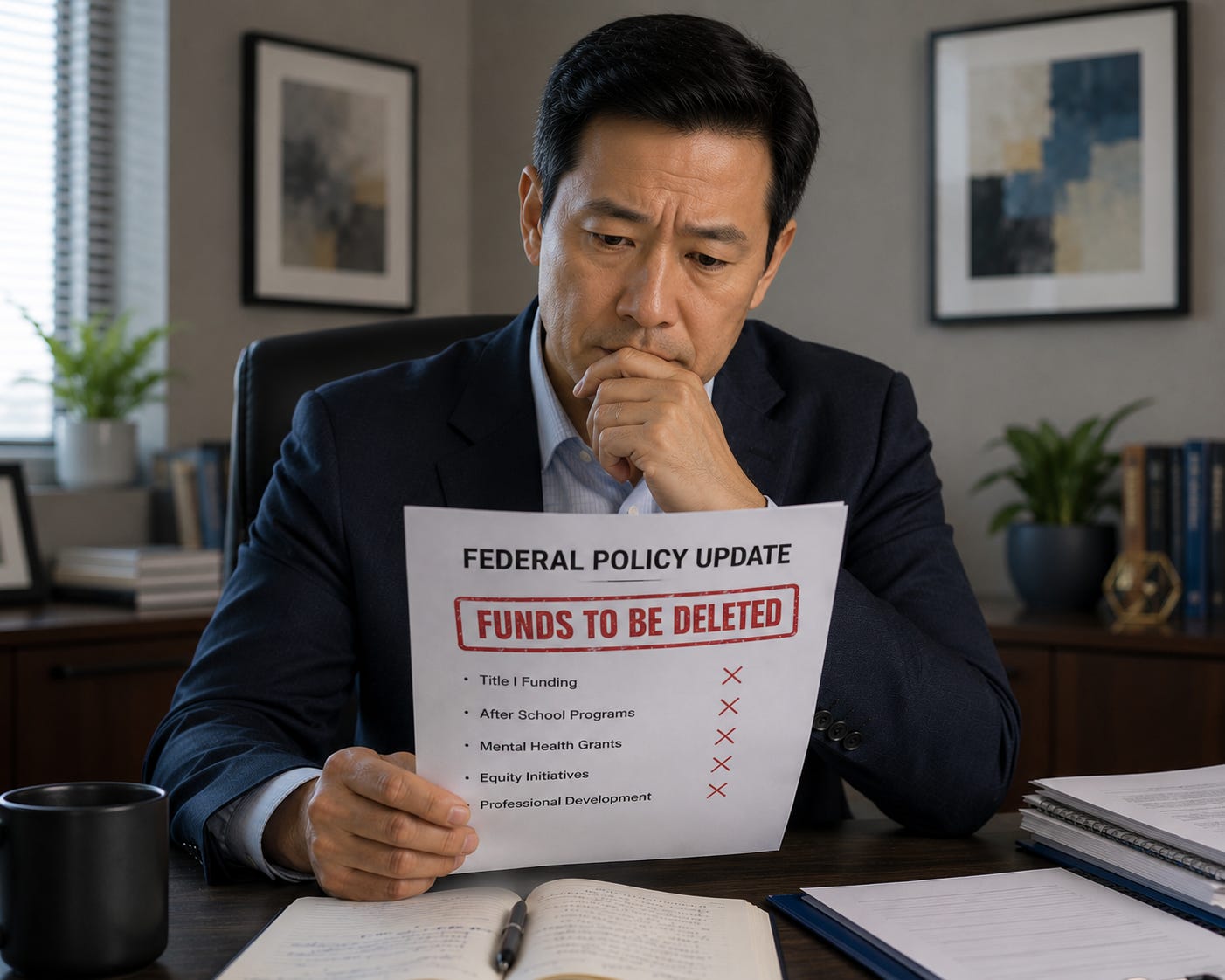
Title I funding serves the students with the highest need. Every dollar that disappears from that allocation hits the most vulnerable kids in your building first. That is not an abstraction. It means your reading interventionist. Your after-school program. Your family engagement coordinator. Your attendance counselor.
When the reduction memo arrives, don’t wait for the district to tell you what it means for your building. Do your own assessment first. Pull every position, program, and service funded fully or partially through Title I. Map what disappears if the allocation drops by 15 percent, then 25 percent, then 40 percent. Build three scenarios.
Then communicate with your staff before the rumor does. People will find out. The question is whether they hear it from you with context and a plan, or through the grapevine with fear and no information.
Advocate. Loudly and through every legitimate channel available. Contact your state education agency. Work with your union leadership if applicable. Support your district in communicating to board members and legislators what the real-building impact looks like. Numbers in a policy memo are abstract. A list of positions eliminated and programs cut is not.
The money may come back. It may not. Either way, your students need a leader who saw it coming and didn’t wait to respond.
TRANSFERABLE PRINCIPLE
When federal funding shifts, school leaders who built scenarios early have options. Those who waited have cuts.
Build a funding-impact analysis before you need it. Map every Title I-funded position and program in your building. Develop three reduction scenarios with specific consequences for students named in each. Communicate with your staff before the rumor cycle starts. Advocate through legitimate channels with real data. School leaders who engage the funding threat proactively protect more of what their students need than those who absorb the news passively.
Until next time — the chair is yours.
Next issue: A community donor offers to fund a program the district just eliminated. You need to think carefully.
I’m curious to learn how administrators are thinking about the upcoming education freedom tax credit as a means to potentially fill that gap - and if that thinking is realistic given the known limits given to the use of those funds by the IRS. (FWIW, I think it’s a slippery slope from “let’s use this private money for things we need” to “whoops, public schools aren’t so public anymore!” … so I’m not actually advocating for this.)
A practical report with intelligent, pragmatic advice, no, better: applicable assistance to guide your crew through troubled waters looming ahead.